
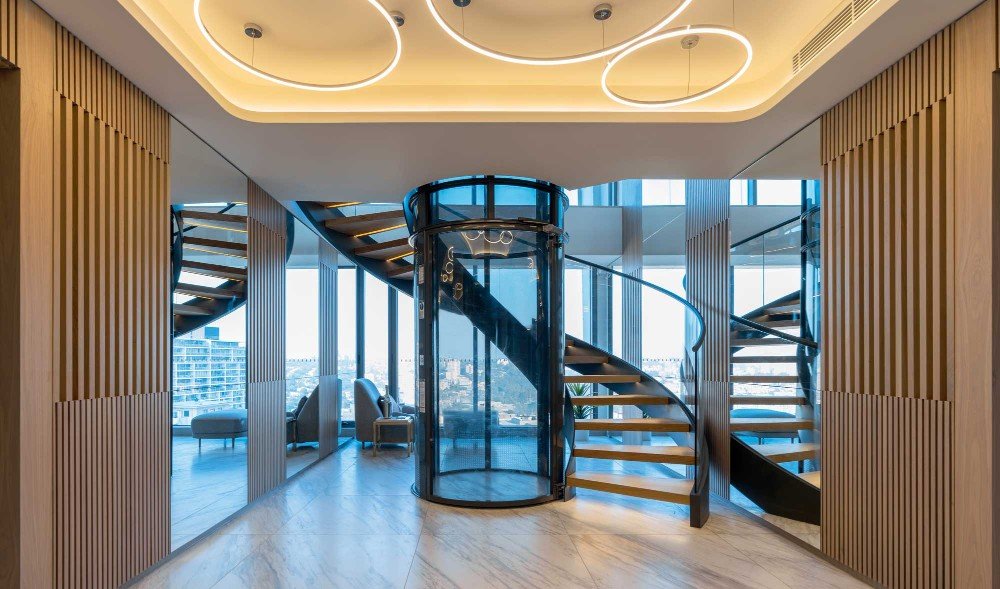
What if you could install a stylish, high-tech lift in your double-brick Perth home without the stress of digging a deep concrete pit or losing an entire room to a bulky structural shaft? Many Western Australian homeowners find themselves at a crossroads when considering PVE vs traditional elevators, often feeling torn between the reliability of time-tested designs and the sleek, space-saving appeal of modern vacuum technology. It’s a significant investment, and it’s natural to worry about how a major installation might disrupt your daily life or impact the character of your residence.
We understand that you’re looking for more than just a piece of machinery; you’re seeking a long-term mobility partner that fits seamlessly into your existing floor plan. This guide provides a transparent, comprehensive comparison of pneumatic vacuum technology versus conventional lifts to help you choose the perfect accessibility solution for your unique needs. We’ll break down the differences in installation time, maintenance requirements, and how each system complies with the latest Australian Standards, ensuring you can make an informed decision with absolute confidence and peace of mind.
Key Takeaways
- Understand the fundamental engineering differences between air-driven vacuum systems and mechanical traction to identify which technology best aligns with your home’s structural integrity.
- Discover why PVE models are often the superior “surgical” retrofit for Perth’s double-brick homes, as they bypass the need for deep concrete pits and extensive structural renovations.
- Evaluate the lifestyle benefits of PVE vs traditional elevators by comparing the space-saving, 360-degree panoramic design against the heavy-duty capacity of conventional models.
- Learn how to minimise long-term running costs through gravity-assisted descent technology and simplified maintenance schedules that prioritise your peace of mind.
- Gain a clear decision-making framework to help you choose between a futuristic architectural statement and a standard lift based on your specific property type and future-proofing goals.
Understanding the Core Technology: How PVE Differs from Traditional Elevators
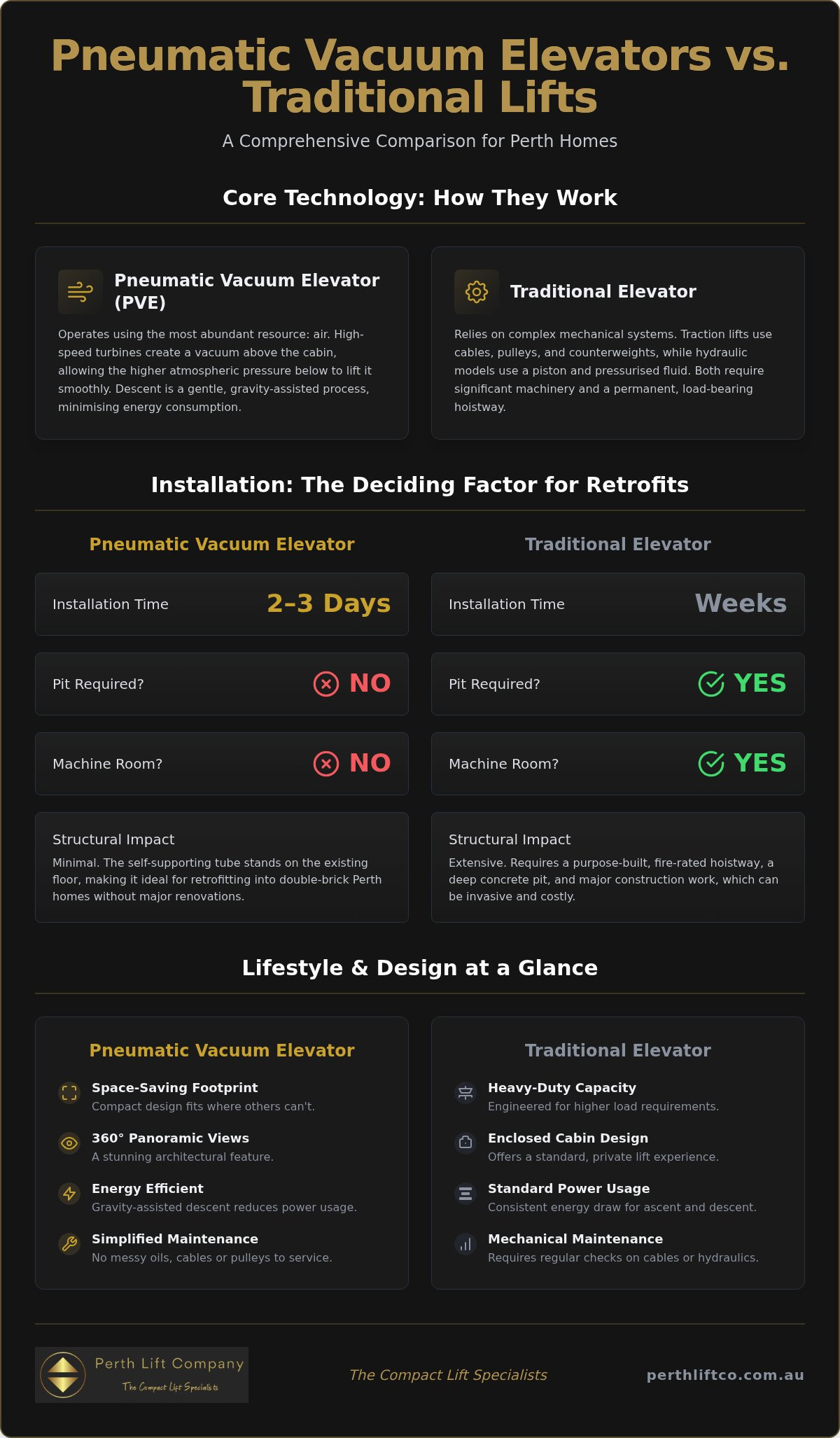
Choosing a lift for your Perth residence often begins with a fundamental question of physics. While traditional elevators rely on complex mechanical systems or fluid pressure, Pneumatic Vacuum Elevators (PVE) use the most abundant resource available: air. This radical departure from standard engineering is why many architects refer to the PVE as a “lift in a tube.” Its self-supporting structure requires no load-bearing walls, making it a distinct alternative to the permanent masonry shafts required by conventional designs.
The Science of Air vs. Cables and Hydraulics
To appreciate the distinction in PVE vs traditional elevators, it helps to look at how elevators work across different categories. Traditional traction lifts operate using a system of motorised pulleys and heavy counterweights to move the cabin through a fixed hoistway. Hydraulic models, on the other hand, rely on a piston and fluid pressure to push the lift upwards from below. Both systems are effective; however, they involve numerous moving parts and significant mechanical friction.
In contrast, a PVE uses a high-speed turbine motor to create a vacuum seal within its circular shaft. By reducing the air pressure above the cabin, the lift is pulled upwards by the higher pressure below it. For the descent, the system slowly releases air back into the chamber, using gravity to bring you back down safely. This streamlined approach eliminates the need for messy oils, heavy cables, or the constant mechanical adjustments required by older technologies.
Component Comparison: No Pit, No Machine Room, No Problem
The structural footprint of your lift is where the differences become most apparent. Traditional elevators are permanent fixtures that require significant excavation for a concrete pit at the base and a dedicated machine room to house the motor and control systems. In many Perth homes, especially those with double-brick construction, these requirements can lead to expensive and invasive renovations. When comparing PVE vs traditional elevators for a retrofit, the component requirements differ significantly:
- Traditional Lifts: Require a hoistway, a pit (usually 150mm to 1000mm deep), and overhead clearance for machinery.
- Pneumatic Vacuum Elevators: Require only a finished floor and a power supply; the lift stands directly on the existing surface.
PVE models, such as the PVE 30, 37, or 52, offer a “plug and play” solution. There is no need to cut into your concrete slab or sacrifice a cupboard for a machine room. Because the tube is self-supporting, it can be installed in places where a traditional shaft simply wouldn’t fit, such as in the centre of a spiral staircase or a tight corner of a hallway. This lack of structural dependency is a major reason why vacuum technology is increasingly popular for modern WA retrofits.
Installation and Structural Requirements in Perth Homes
Perth’s residential architecture presents a specific set of challenges for homeowners looking to improve accessibility. The prevalence of double-brick construction in Western Australia means that retrofitting a traditional lift often requires significant engineering to manage load-bearing walls and heavy masonry. This is a primary factor in the PVE vs traditional elevators debate. While a conventional lift requires a permanent, fire-rated shaft, a Pneumatic Vacuum Elevator is a self-supporting modular system that places far less stress on your home’s existing structure.
The installation timeline is perhaps the most striking difference for a local homeowner. A traditional lift installation is a major construction project that can span several weeks, involving multiple trades, council permits, and significant mess. In contrast, a PVE can typically be installed in just two to three days. Because the weight is distributed evenly across the existing floor without the need for specialised footings, the structural impact is kept to an absolute minimum.
Retrofitting PVE into Existing Western Australian Residences
For those living in iconic Perth coastal suburbs or heritage-listed properties, maintaining the original floor plan is often a priority. PVE models offer incredible flexibility with “through-floor” or “balcony-mount” configurations. A through-floor installation requires only a circular opening in the ceiling, while a balcony-mount attaches directly to the edge of a mezzanine or landing. This versatility allows the lift to be placed in areas where a traditional shaft simply wouldn’t fit, such as a hallway or the centre of a staircase. If you are unsure which configuration suits your floor plan, our team at Perth Lift Company can provide a tailored assessment of your space.
This “surgical” approach avoids the “building site” feel that often accompanies home modifications. There is no need for deep excavation or the removal of large sections of your home’s double-brick interior. The modular components are brought in through standard doorways, ensuring your daily life remains largely undisturbed during the brief installation window.
Traditional Elevator Shaft and Pit Construction Demands
Choosing a traditional elevator involves a commitment to permanent masonry. These systems require a dedicated hoistway and a concrete pit, which usually ranges from 150mm to 1000mm deep. In Perth, digging a pit can be complicated by underground services like plumbing or electrical lines, and even the local water table in riverside suburbs. While global residential elevator safety codes provide a framework for these installations, the physical reality of cutting into a concrete slab is both invasive and costly.
Additionally, many traditional traction or hydraulic lifts require a three-phase power supply to handle the heavy mechanical loads. This often necessitates an expensive upgrade to your home’s electrical switchboard. When evaluating PVE vs traditional elevators, it’s vital to account for these “hidden” site preparation costs, which are virtually non-existent with the single-phase, plug-and-play vacuum technology.
Performance and Lifestyle Comparison: Space, Speed, and Sound
Beyond the structural considerations discussed earlier, the daily experience of using your lift is what truly defines its value within your home. When comparing the performance of PVE vs traditional elevators, you must consider how the system interacts with your residence’s light, available space, and acoustics. While a traditional lift offers a familiar, enclosed experience, the pneumatic alternative introduces a level of architectural transparency that can transform the “feel” of a room. Your choice ultimately depends on whether you prioritise heavy-duty lifting capacity or a minimal, modern footprint.
Maximising Floor Space with Compact Circular Designs
For many Perth homeowners, particularly those in modern townhouses or downsizer apartments, every square metre is precious. The PVE30 is a standout solution in these scenarios. It is a single-passenger lift with a remarkably tiny 750mm diameter footprint, allowing it to fit into spaces where a traditional square shaft would be impossible. Because the design is circular, it offers 360-degree orientation. This flexibility means you can organise entry and exit points on different sides for each floor, ensuring the lift integrates perfectly with your existing hallways and landings without requiring awkward internal cab reconfigurations.
Traditional elevator cabs are typically rectangular, which often leads to “dead space” in corners once the safety shaft is constructed. While they are superior for moving large furniture or multiple passengers at once, they consume significantly more floor area. If your primary goal is personal mobility within a tight floor plan, the streamlined profile of a vacuum lift ensures you don’t lose an entire corner of your living room to a bulky mechanical enclosure.
The Passenger Experience: Panoramic Views vs. Enclosed Cabs
The aesthetic impact of your lift choice is profound. Traditional elevators often feel like a “box within a box,” which can be claustrophobic in smaller residential settings. In contrast, PVE models utilise transparent polycarbonate panels that maintain sightlines and allow natural light to flow through your home. Panoramic visibility serves as a key psychological benefit for users, as the constant connection to the surrounding room alleviates the sense of confinement often found in traditional elevators. For homeowners who want to explore this design philosophy further, our guide to round glass lifts for homes Perth explains how these panoramic solutions can turn a functional necessity into a breathtaking architectural feature. This transparency makes the lift feel like a piece of high-end furniture rather than a heavy industrial addition.
Acoustics also play a role in your long-term satisfaction. Modern traction motors are exceptionally quiet, often producing little more than a faint hum during operation. A PVE system, however, uses a vacuum turbine that produces a sound similar to a high-powered vacuum cleaner during ascent. It’s a purposeful sound that reflects the technology at work. While the PVE is slightly louder than a premium traction lift, it’s worth noting that it is completely silent during descent as it relies solely on gravity. When weighing PVE vs traditional elevators, consider whether the silent operation of traction is worth the extra construction time, or if the brief turbine sound of a PVE is a fair trade for a faster, cleaner installation.
The Real Cost of Ownership: Maintenance, Energy, and Longevity
Investing in a home lift is a commitment to the future of your property. While the initial installation is a major milestone, the long-term value lies in the efficiency and reliability of the system you choose. When evaluating PVE vs traditional elevators, the cost of ownership extends far beyond the purchase price. In the Western Australian climate, factors like energy consumption and mechanical wear due to heat play a significant role in determining which technology provides the best return on investment over fifteen or twenty years.
Energy Consumption and Sustainable Mobility
One of the most compelling advantages of pneumatic technology is its eco-friendly operational model. PVE systems use a standard 240V power outlet, similar to a common household appliance, rather than the high-draw industrial power systems often required by traditional traction lifts. Because the cabin descends using gravity alone, the lift consumes zero electricity on the way down. This gravity-based descent significantly reduces your home’s carbon footprint compared to hydraulic systems that must pump fluid or traction systems that engage motors for every movement.
For homeowners focused on sustainable living in WA, this efficiency translates to lower utility bills and less strain on your electrical infrastructure. It’s a clean, modern approach to mobility that aligns with the values of future-proofing your residence for an energy-conscious world. By choosing a system that minimises power draw, you’re making a choice that is as kind to your bank account as it is to the environment.
Servicing Schedules and Long-Term Reliability in WA
The mechanical simplicity of a vacuum lift is a major asset for long-term reliability. Traditional hydraulic elevators rely on seals, valves, and fluid pressure, which can be prone to leaks or degradation over time, especially in the dry heat of a Perth summer. In contrast, PVE systems have fewer moving parts to wear out. The primary maintenance task is typically the replacement of the main vacuum seal after approximately 15,000 rides, a predictable and straightforward process compared to the complex overhauls sometimes required for older cable-driven models.
Ensuring your lift remains compliant with Australian Standards, specifically the current AS 1735 series, is essential for both safety and property resale value. Research suggests that a quality residential lift can increase a property’s resale value by up to 20%. This is why we focus on future proofing home with lift technology that meets the latest benchmarks, such as AS 1735.1.1:2022. Having a local partner for ongoing registration and support ensures your investment remains a safe, reliable asset for decades to come.
If you’re ready to explore a low-maintenance mobility solution that stands the test of time, you can contact our Perth-based specialists to discuss the best fit for your home and receive expert guidance on the latest regulatory requirements.
Making the Right Choice for Your Perth Property
Deciding between PVE vs traditional elevators isn’t just a matter of comparing technical specifications; it’s about finding the solution that aligns with your home’s architecture and your family’s future. While we’ve explored the mechanics and the costs, the final choice often hinges on whether you are working with a blank canvas or an established residence. Every Perth home has its own character, and the “best” lift is the one that enhances that character while providing effortless mobility.
When to Opt for a Pneumatic Vacuum Elevator
A pneumatic vacuum elevator is often the superior choice for retrofitting into existing multi-storey townhouses in suburbs like Subiaco or Cottesloe. In these established areas, space is at a premium and the thought of major structural renovations can be daunting. If you value a “minimal mess” installation that preserves your existing floor plan, the PVE is likely your best fit. It acts as a functional piece of art, making a bold architectural statement without the need for a permanent masonry shaft.
For households that require more than single-passenger transit, the PVE37 and PVE52 models provide excellent alternatives. The PVE37 offers a comfortable two-passenger capacity, while the PVE52 is designed specifically for wheelchair mobility. These models allow you to enjoy the benefits of vacuum technology even when your accessibility needs are more demanding. They are ideal for homeowners who want to age in place without sacrificing the aesthetic appeal of their residence.
Future-Proofing with Perth Lift Company’s Expert Guidance
While the PVE is a master of the retrofit, we also recognise that some projects require different strengths. A traditional lift might be the winner for new builds where a shaft can be integrated into the initial blueprints, or for high-traffic environments that demand heavy-duty, industrial-grade lifting. However, there is also a modern middle ground. Many Western Australians are now exploring alternatives like SWIFT lifts, which combine battery-powered efficiency with a sleek, screw-driven design that bridges the gap between vacuum and traction technology.
Before you sign a contract, we recommend a final checklist to ensure your investment is sound:
- Does the lift comply with the latest AS 1735 safety standards?
- Has a structural assessment been conducted on your home’s flooring?
- Does the cabin size accommodate your current and potential future mobility aids?
- Is there a local, WA-owned partner available for long-term servicing and registration?
At Perth Lift Company, we collaborate closely with your architect or builder to ensure a seamless fit from start to finish. We believe in transparency and meticulousness, ensuring you feel supported throughout the entire process. If you’re ready to see these technologies in person and discuss which model suits your lifestyle, you can book a consultation at our Perth showroom to experience the future of home mobility first-hand.
Securing Seamless Mobility for Your Future
Choosing between PVE vs traditional elevators is a significant decision that ultimately shapes the comfort and longevity of your home. We’ve explored how vacuum technology offers a surgical, space-saving installation for existing residences, while traditional systems remain a robust choice for specific new-build requirements. Regardless of the path you take, ensuring your lift is fully compliant with current AS1735 standards is vital for your long-term safety and property value.
As the WA Regional Agent for Pneumatic Vacuum Elevators and expert retrofit specialists, Perth Lift Company is dedicated to providing reliable, professional guidance tailored to your unique needs. We understand the technical nuances of local building codes and are committed to being your steady partner throughout the entire modification process. Discover the perfect lift for your Perth home—Contact Perth Lift Company today. We’re excited to help you enhance your daily environment with a mobility solution you can trust for years to come.
Frequently Asked Questions
Is a PVE safer than a traditional elevator during a power failure?
PVE models are exceptionally safe during power outages because they don’t rely on complex electrical backups to return to the ground. If the power fails in your Perth home, the vacuum seal slowly releases, allowing the cabin to descend to the lowest level using gravity alone. While traditional lifts often require expensive battery backup systems or manual emergency lowering by a technician, a vacuum lift provides immediate peace of mind for those worried about being stranded.
Can I install a PVE in an existing two-storey home in Perth?
You certainly can, and it is often the preferred choice for retrofitting existing residences across Western Australia. Because these systems are self-supporting and don’t require a concrete pit or a structural hoistway, they can be installed through a simple circular hole in the floor. This makes them perfect for double-brick Perth homes where traditional excavations are difficult. The installation is typically completed in just a few days with minimal disruption to your household.
How much weight can a pneumatic vacuum elevator actually carry?
The weight capacity depends on which of the three models you choose for your property. The single-passenger PVE 30 carries up to 159kg, while the two-passenger PVE 37 handles 205kg. If you require wheelchair accessibility or need to move multiple people, the PVE 52 has a capacity of 238kg. These specifications ensure that most residential mobility needs are met without the heavy mechanical overhead of a larger industrial elevator system.
Are vacuum lifts noisier than standard residential elevators?
Vacuum lifts produce a sound comparable to a high-powered vacuum cleaner, but only during the ascent. This is because the turbine motors are creating the pressure difference needed to lift the cabin. When comparing PVE vs traditional elevators, it’s worth noting that the vacuum system is completely silent during descent. Traditional traction lifts are generally quieter during operation, but they require significantly more structural work and permanent space within your home’s floor plan.
Do I need to undergo major building works for a PVE installation?
No major structural renovations are typically required for these installations. Unlike traditional elevators that need a deep pit dug into your foundation and a dedicated machine room, the PVE stands directly on your existing finished floor. The only significant building work involves creating an opening in the ceiling for the tube to pass through. This “surgical” approach is why many Perth homeowners choose vacuum technology to avoid the mess and cost of traditional shaft construction.
What is the maintenance schedule for a PVE compared to a cable lift?
PVE systems are remarkably low-touch because they have very few moving parts and don’t use messy oils or cables. The primary maintenance requirement is a seal replacement after approximately 15,000 rides. In contrast, traditional cable or hydraulic lifts require more frequent inspections of pulleys, fluid levels, and mechanical tension. For Perth residents, this means fewer service visits and a more predictable long-term ownership experience compared to the high-maintenance requirements of conventional lift technologies.
Does a PVE comply with Australian Safety Standards (AS1735)?
Yes, every lift we supply and install is fully compliant with the relevant sections of the Australian Standard AS 1735 series. When weighing up PVE vs traditional elevators, safety and regulatory compliance are our top priorities. We ensure that your installation meets all Western Australian building codes and WorkSafe WA requirements. This compliance is essential for your peace of mind and ensures that the lift remains a legal, value-adding asset to your property for many years.
Which lift technology adds the most value to a Perth property?
Both technologies can increase a home’s resale value by up to 20%, but the “best” value depends on your specific house. A PVE often adds more value to existing high-end Perth homes because it serves as a modern architectural feature without destroying the original floor plan. Traditional lifts are excellent for new builds where they can be integrated seamlessly. Choosing a reliable, locally supported solution ensures your investment remains an attractive feature for future buyers in the WA market.