
Could a lift change your Perth home’s electricity use more than you expect, or less? It’s a fair question when planning an accessible home, especially if energy efficiency is part of the design. Energy efficient home elevators don’t all use power in the same way: lift technology, travel distance, frequency of use and standby power can all affect consumption.
This guide explains what can influence a home lift’s energy use and which specifications to compare. You’ll also learn how to factor lift placement and operation into your home plans, so accessibility and comfortable living work alongside energy-conscious choices. Perth Lift Company supplies and installs residential lift solutions, working with homeowners, builders and architects to tailor them to each project.
Key Takeaways
- Compare energy efficient home elevators using model-specific information about operation and standby power, not broad efficiency claims.
- Consider how drive technology, travel distance, lift configuration and household use may affect energy consumption.
- Plan lift requirements with your home layout early, so accessibility and design choices can be considered together.
- Balance energy information with everyday access and future household needs when planning a lift for your Perth home.
What makes an energy efficient home elevator?
Efficiency is best judged in context: how much electricity a lift uses to provide the journeys and access a household needs. Consumption can vary with the lift’s specifications, installation, travel distance, frequency of use and standby power. A general “efficient” claim is difficult to assess without comparable energy information for the specific models.
A useful definition: “A home elevator’s energy consumption is the electricity it uses to operate and remain on standby over a stated period; its efficiency describes that use in relation to the service it provides.” Comfort, accessibility and design also matter when choosing a lift, but they don’t, by themselves, indicate how much power it uses.
Does a home elevator use power when it is not moving?
It can. Standby power is the electricity used while the lift is waiting between trips, for controls and other systems that remain active. The amount can differ between models, so include it in your comparison rather than assuming it is negligible. Check manufacturer information for standby consumption as well as energy used during operation. For a fair comparison, check that figures use the same units, timeframe and operating assumptions.
Why efficiency means more than the drive system
Drive technology is one part of the picture. The lift’s configuration, travel distance, installation and household travel patterns also influence its overall electricity use. A lift making frequent trips between levels may have a different usage profile from one used occasionally, even if their drive systems are similar. For background on how lift systems work, see this overview of elevator technology.
That’s why energy efficient home elevators shouldn’t be ranked by lift type alone. Compare operating and standby specifications under similar conditions, then consider the journeys the lift needs to make. A well-planned choice balances energy information with household access needs, comfort and the home’s layout.
How home elevator technology and everyday use affect energy consumption
The drive system is only one part of the energy picture. Lift configuration, the distance between stops and how often the lift travels all affect the work it performs. A battery may support particular features or operation, but its presence alone doesn’t show that a lift uses less electricity overall. Compare the complete operating information for each model.
What specifications help homeowners compare lift energy use?
Look for rated power, standby consumption and the conditions used to measure them. A power rating alone doesn’t tell you how much electricity a lift will use over time, because consumption also depends on how it operates in the home. When comparing specifications, note the measurement units, timeframe and test conditions beside each figure. If a figure isn’t published, or two figures use different conditions or units, record that the comparison is incomplete rather than estimating.
| Characteristic | What to compare |
|---|---|
| Drive technology | The system used and its published operating data. Don’t assume one type is more efficient without comparable figures. |
| Configuration and travel | Number of stops and travel distance, alongside energy figures measured under stated conditions. |
| Standby and battery features | Published standby consumption and what the battery powers. A battery feature isn’t proof of lower total consumption. |
Assess energy performance model by model, using comparable specifications and the household’s expected pattern of use.
How often the lift travels changes the energy picture
Consider two everyday scenarios: a lift used for a few essential trips each day, and one travelling repeatedly between levels as household members move around. The second pattern involves more journeys, while a longer route also means more travel distance per trip. These examples illustrate why usage matters; they are not measured energy results for a particular lift.
As you compare residential lift options, match the published specifications to the home’s layout and likely travel patterns. This gives you a clearer basis for assessing energy efficient home elevators without relying on broad claims.
How to plan an energy-conscious home elevator in Perth
A considered plan brings household needs, home design and energy information together. In Perth, planning can differ depending on whether you’re building, renovating or fitting a lift into an existing home. Available space and the building layout help determine what will work. Bring the homeowner, builder and architect into the discussion early, so lift requirements can be considered alongside the wider design.
Planning a lift for a new build or renovation
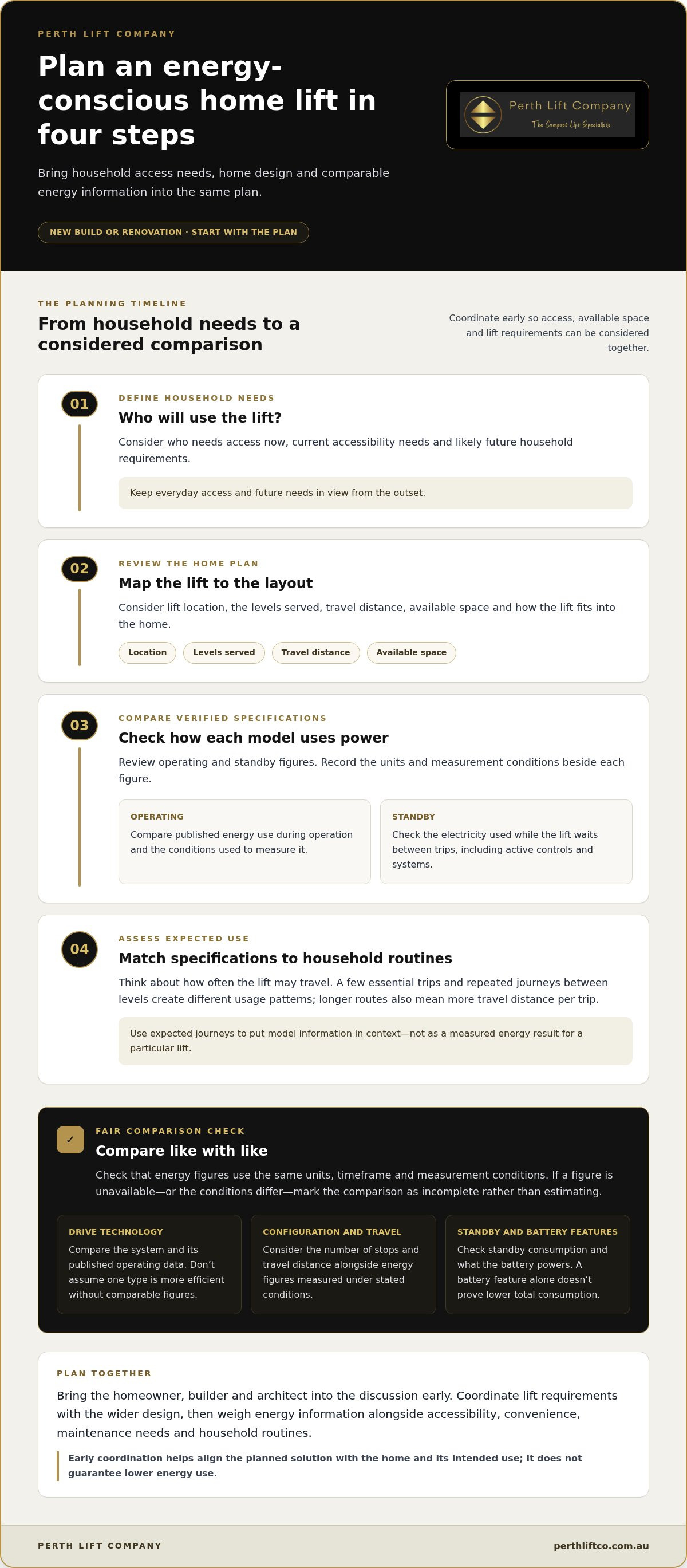
Start with four steps:
- Define household needs: Consider who will use the lift, current accessibility needs and likely future requirements.
- Review the home plan: Consider lift location, levels served, travel distance and how the lift fits into the layout.
- Compare verified specifications: Review operating and standby figures, noting their units and measurement conditions.
- Assess expected use: Think about household routines and how often the lift may travel.
Early coordination lets the project team consider access, space and lift requirements as part of one design. It doesn’t guarantee lower energy use, but it helps align the planned solution with the home and its intended use.
A practical checklist for comparing energy information
Compare like with like. Check whether operating and standby figures use the same units, time periods and test conditions. If a figure is unavailable or the conditions differ, note that rather than estimating. Then weigh energy information alongside accessibility, convenience, maintenance needs and household routines. This helps you assess energy efficient home elevators against the service they need to provide.
For an existing home, the structure and available space can shape lift placement and the planning options. Perth Lift Company works with homeowners, builders and architects to supply and install tailored residential lift solutions. Explore residential lift options as part of planning a lift that suits your home and household needs.
Choosing a home elevator for long-term efficiency and accessibility
A suitable lift should meet household access needs while fitting the home’s layout and long-term plans. Compare energy information alongside practical considerations such as who will use the lift, how the home is arranged and what level of access may be needed in future. No single specification tells the whole story.
Matching lift planning to the household
Daily routines can help clarify priorities. A household planning for ageing in place may prioritise straightforward access between key living areas, while another may focus on making different levels more usable for a family member with mobility needs. The home’s design, available space and expected use all shape the decision. Consider energy efficient home elevators as part of this broader balance, rather than choosing on an efficiency claim alone.
Perth Lift Company works with homeowners, builders and architects to tailor residential lift solutions to each project. The SWIFT Pro residential lift is one option to explore, considering the home’s access requirements and design alongside the product information.
Explore residential lift options in Perth
Perth Lift Company supplies and installs SWIFT Pro Lifts, SWIFT Lite Lifts, pneumatic vacuum elevators and platform lifts. Each project has its own requirements, so compare options against the household, building and intended use. Reviewing the range can help you identify a suitable solution without assuming that one lift type is automatically more energy efficient.
Explore home lift solutions and compare the options against your priorities for accessibility, layout and energy information.
Plan a lift that suits your home and future
Choosing a lift is about more than a headline efficiency claim. Energy use depends on the model’s specifications and how it’s used, so compare operating and standby information on a like-for-like basis. Also consider access needs, household routines and the home’s layout together. This is how energy efficient home elevators can be assessed as part of a practical, future-minded home plan.
Perth Lift Company is locally owned and operated, serving Perth and Western Australia. The company supplies and installs tailored residential lift solutions, working with homeowners, builders and architects to consider options that fit each project and support accessibility and everyday comfort.
Take the next step: explore residential lift solutions for your home and consider which options suit your household and plans. Thoughtful planning can help you choose a lift that supports comfortable living now and into the future.
Frequently Asked Questions
Does a home elevator use a lot of electricity?
There’s no single electricity-use figure that applies to every home elevator. Consumption can vary with the model and drive system, travel distance, frequency of use and standby behaviour. To understand the likely energy impact in your Perth home, compare published specifications on a like-for-like basis, then consider how the lift will fit into your household’s daily routines.
Are battery-powered home elevators more energy efficient?
Not necessarily. Battery-powered describes an aspect of how a lift operates, but it doesn’t prove lower overall energy consumption. Performance depends on the specific system, how it’s used and its published energy information. Compare operating and standby figures for the models you’re considering, including units and measurement conditions, rather than treating a battery feature alone as an efficiency rating.
How can I reduce the energy use of a home elevator?
Choose a lift that suits your home and expected use, then compare reliable operating and standby specifications. If you’re building or renovating in Perth, include lift location and requirements in early design discussions with your project team. This supports considered planning, but don’t assume a particular feature will reduce consumption unless model-specific information supports that claim.
Can a home elevator be added to an existing Perth house?
A lift can be planned for an existing Perth home, although the layout, available space, access needs and building work will shape the options. Energy use is one consideration alongside practical fit and accessibility. For more context on planning a lift in an established home, read the Perth existing-home elevator retrofit guide.
What should I compare when choosing an energy efficient home elevator?
Compare published operating and standby energy figures, and check that they use comparable units and measurement conditions. Then consider how often the lift will travel, the home’s layout, accessibility requirements and longer-term household plans. A sound decision on energy efficient home elevators weighs verified energy information alongside practical suitability, rather than relying on one specification or a broad claim.